
"What's wrong?" is a really hard question if your brain doesn't hand you the answer.
Think about the last time you were completely overwhelmed and someone asked you to explain yourself. Maybe all you had was a growl and a strong urge to lie face-down on the floor. Now imagine being seven, with a sock seam that feels like sandpaper and a sibling who took your favorite toy.
Plenty of neurodivergent kids feel feelings huge and fast, and finding the words is a whole separate job. A printable feelings chart won’t make the big feelings disappear. But it can give them a size, a name, and a next step.
Here are five that do that in different ways, and the research behind why they help.
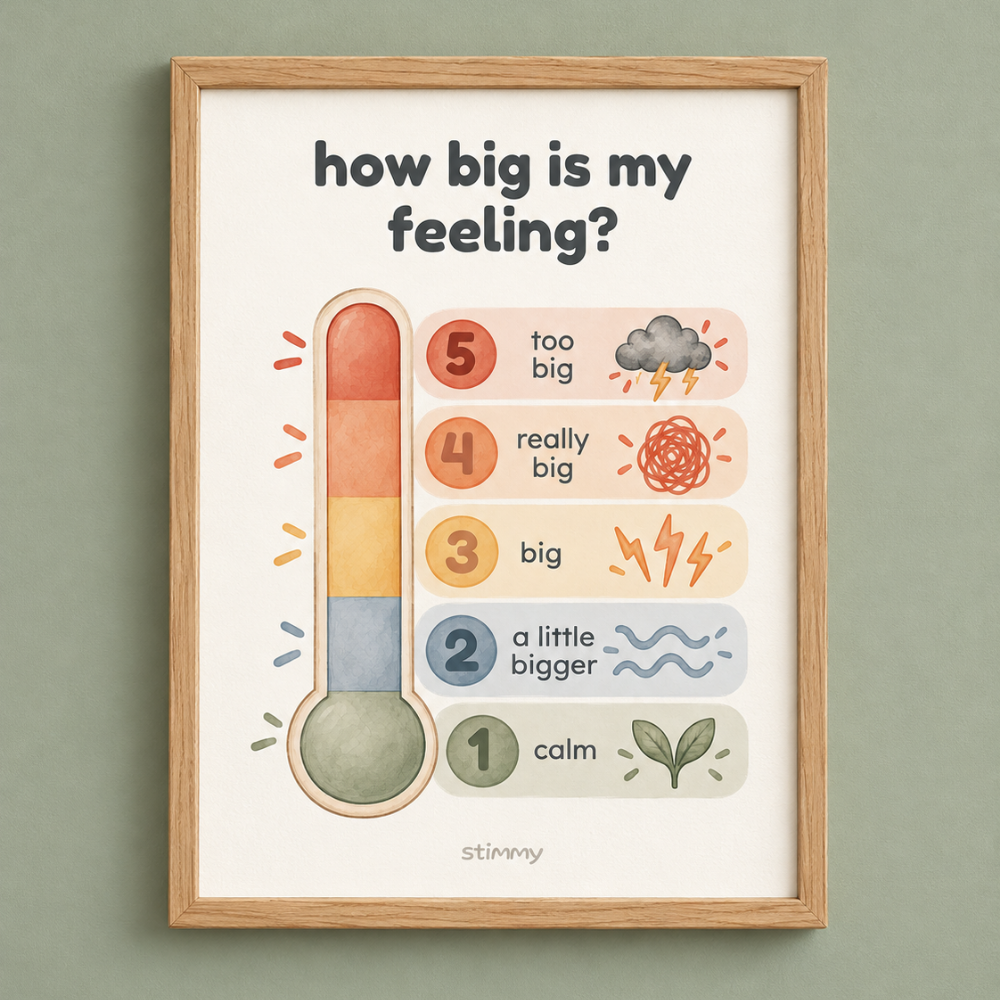
How big is my feeling? A printable feelings chart for big reactions
This is a feelings scale, and it might be the most useful chart for kids whose feelings go from zero to volcano. Instead of asking "what are you feeling?" it asks "how much?" For a lot of kids, that's a way easier question.
There's a reason it lands. For many neurodivergent kids, feelings don't creep in. They kick the door down. A widely cited 2014 review in the American Journal of Psychiatry estimated that roughly 25 to 45% of kids with ADHD have significant trouble regulating emotions.
One minute everything's fine. Then a sibling breathes near the LEGO castle, and we're at a 5.
A scale also cuts way down on words. "I'm at a 3" is a lot easier than "I feel frustrated because the plan changed and nobody asked me." And pointing counts, which is a big deal for kids who use AAC, kids who are non-speaking, and kids who lose their words when it gets loud inside.
Where it really shines is catching the climb. A 2 is a great time for a snack and a quiet minute. A 5 is probably not the moment for a heart-to-heart about anything.
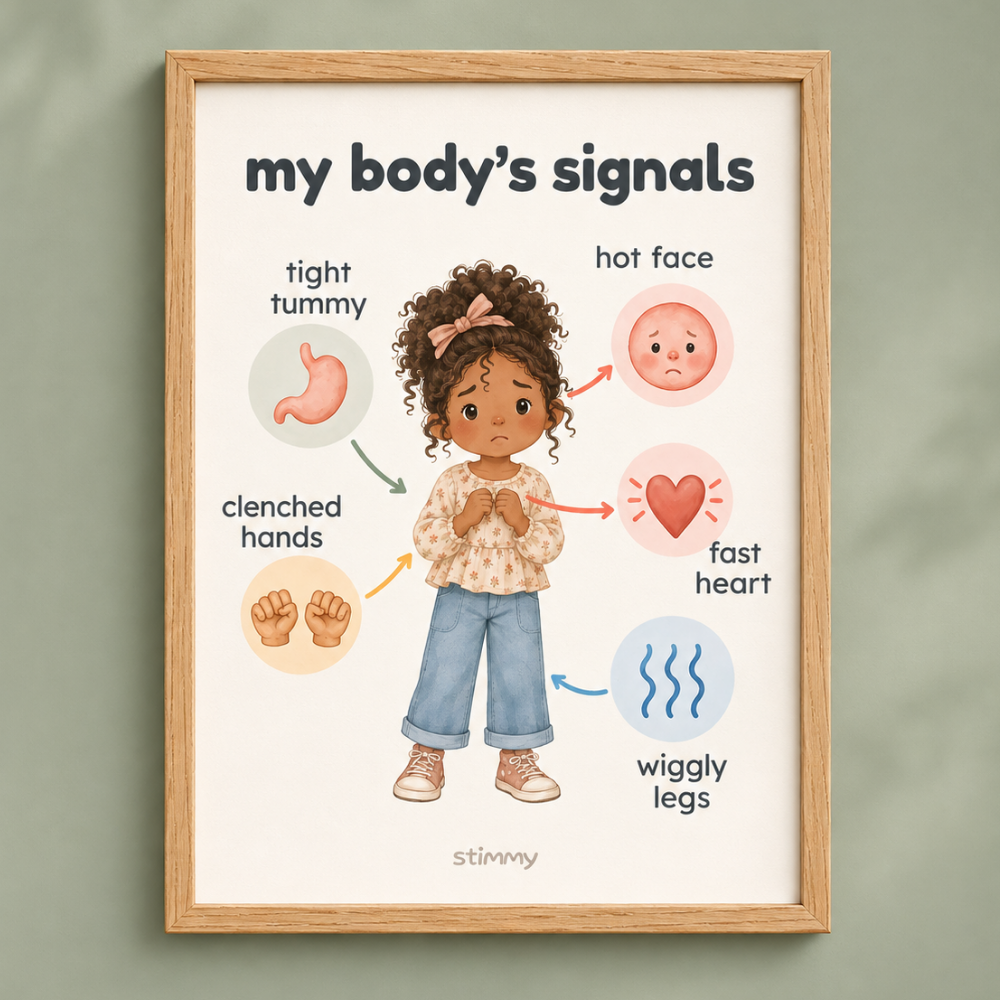
My body's signals: noticing feelings before they have a name
Some kids can't tell you they're anxious. But they can tell you their stomach feels like a washing machine on spin cycle. A body signals chart starts right there, with the clue instead of the word.
Lots of feelings show up in the body before the brain has a label for them. A hot face. Clenched fists. Legs that will not stop bouncing under the dinner table.
The science-y name for this is interoception, your sense of what's happening inside your body.
A 2021 study in the journal Autism asked 100 kids, 45 of them autistic, where in their bodies they felt different emotions. The autistic kids' body maps were less distinct from one feeling to the next.
So for some kids, angry and scared may honestly feel pretty similar on the inside. No wonder "use your words" goes nowhere.
The hopeful part is that body awareness might be something kids can build. In a small 2022 study in Occupational Therapy International, 14 autistic students ages 9 to 19 spent 25 weeks on Kelly Mahler's Interoception Curriculum at school. Caregivers reported gains in body awareness and emotion regulation.
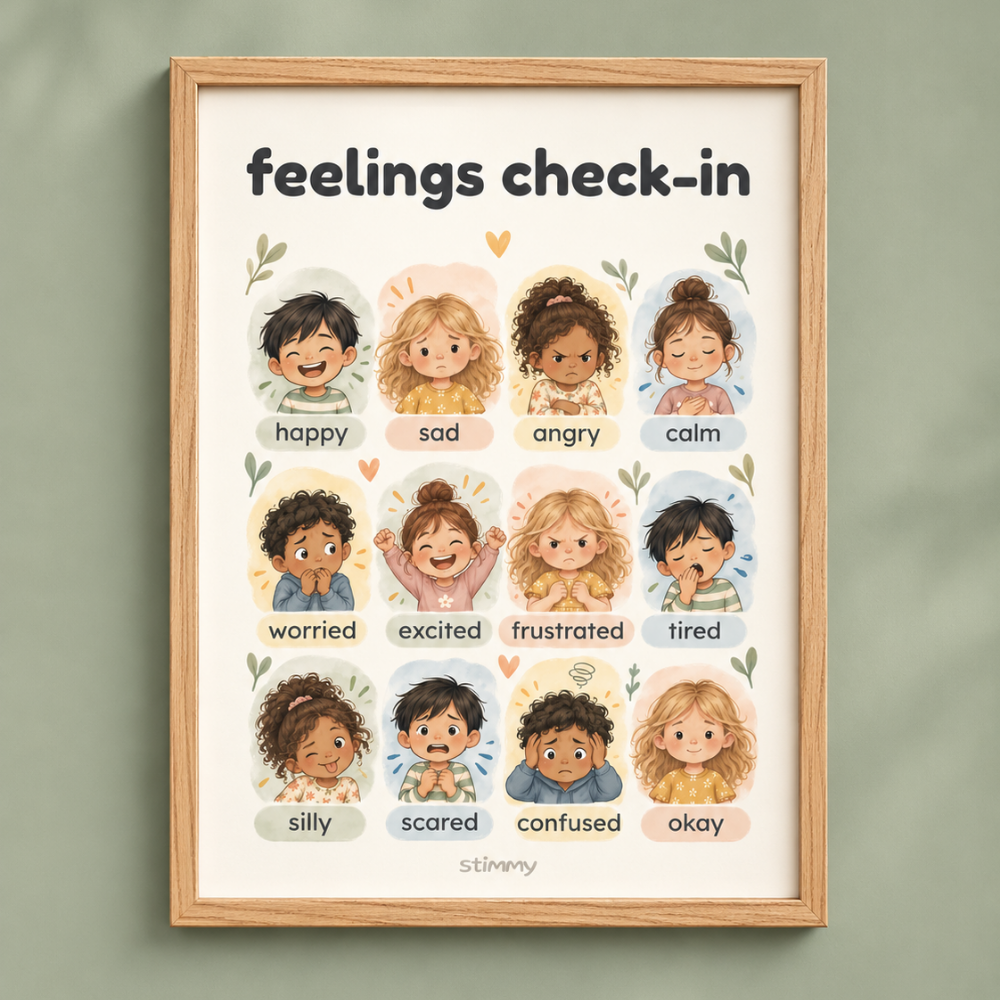
Feelings check-in: a printable feelings chart for "I don't know" days
This is the classic feelings chart most of us picture: faces with names. It's a great fit for the kid whose answer to everything is "I don't know."
"How was your day?" "Fine." Forty minutes later, someone is sobbing because a rogue sock seam is touching them wrong. Sometimes "fine" really means "I can't find the word."
There's a name for that, too: alexithymia (filed in my brain under "words way too long for no reason"). It means real difficulty identifying and describing your own feelings. A 2019 review in European Psychiatry pooled 15 studies and found that about half of autistic participants had high levels of alexithymia, compared with about 5% of neurotypical participants.
The authors suggest that practicing naming feelings might help. Picking "frustrated" off a menu is a lot easier than pulling it out of thin air while you're upset. Families seem to like using it for low-stakes check-ins, like breakfast, the car, or bedtime.
And "okay" and "confused" are totally valid answers. Nobody gets graded on feelings. 🫶
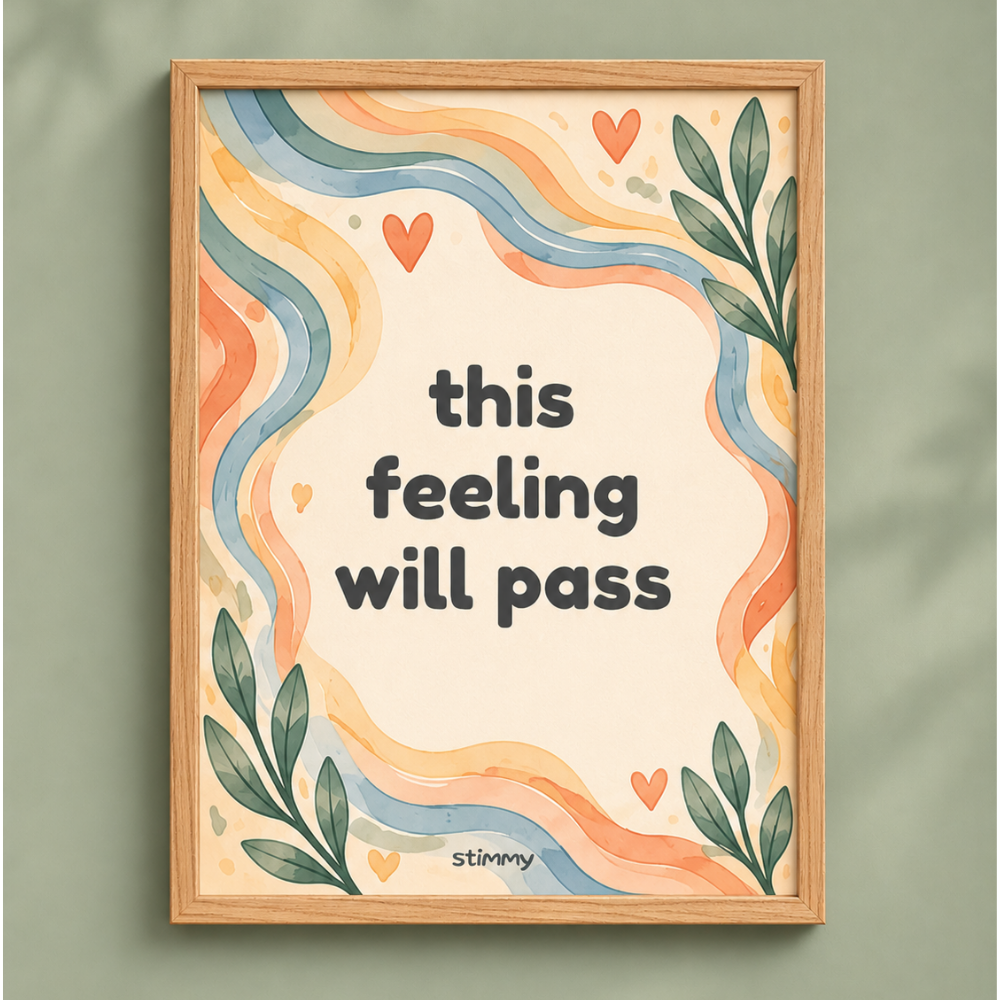
This feeling will pass: a calming corner poster for the hardest moments
Not every feelings chart asks a question. This one is a reminder, for the moments when words and coping skills aren’t accessible for your kiddo.
When a kid is at a 5, a chart full of options can feel like a pop quiz during a fire drill. A kid in full overwhelm isn't in learning mode. So this poster doesn't ask your kid to do anything. It just quietly reminds them the wave has an end.
By the way, this one’s a great reminder for the grown-up, too. When it's the third meltdown before dinner and you're counting down the minutes until bedtime, it helps to have something on the wall to keep you grounded.
Feelings are big. They're also temporary.
📖 RELATED: If afternoons are your hardest stretch, after-school restraint collapse might be part of the picture. It explains why kids who held it together all day sometimes fall apart the minute they walk in the door.
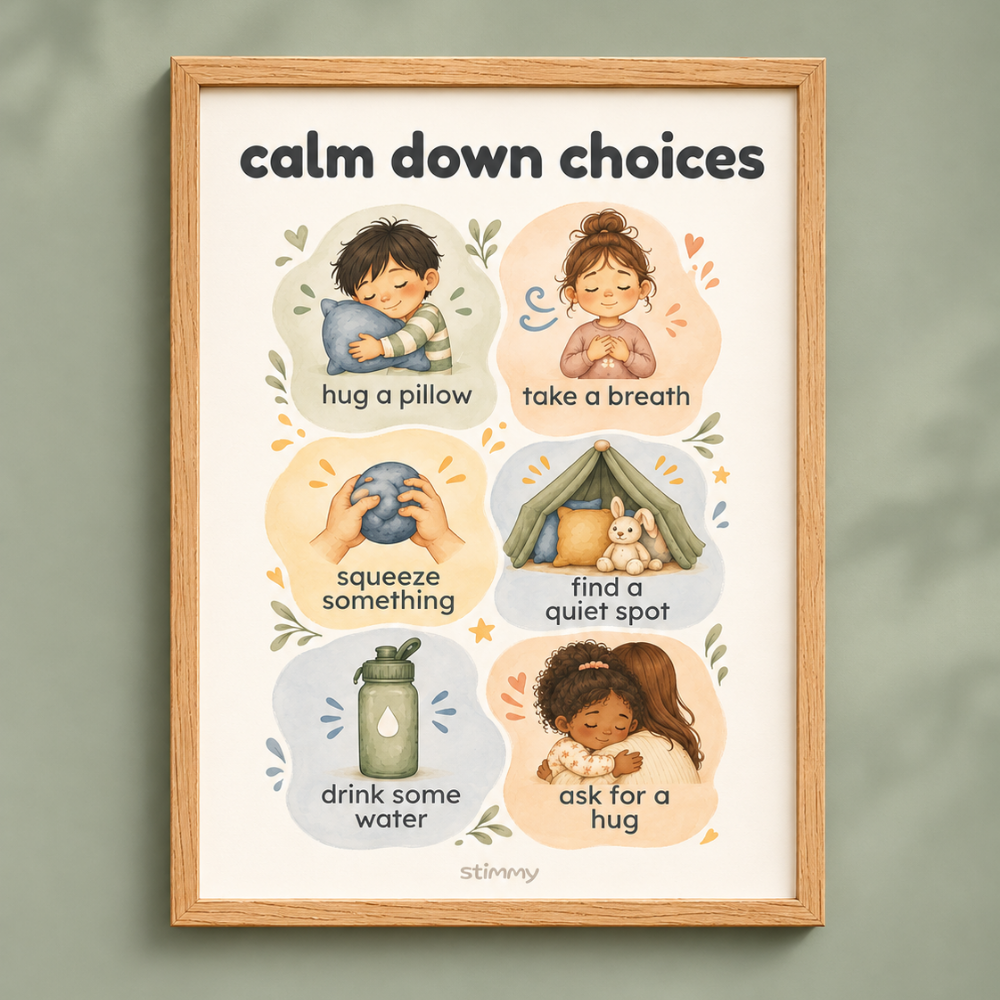
Calm down choices: what to put in a calm down corner
Once a feeling has a size and a name, there's still the big question:
Okay, now what??
A choices chart answers that before anyone has to ask.
Picture-based supports like this have real research behind them. A 2020 national review found that visual supports met the bar for an evidence-based practice for autistic learners from birth to 22, according to the AFIRM summary from UNC. That's backed by 104 single-case studies (the kind that follow one kid closely over time) and 2 group studies.
Plus, this chart kinda feels like a menu. It lets kids pick for themselves, without an adult narrating every step. Autonomy for the win! Huge for PDA kiddos and families.
Plenty of kids would rather grab a drink of water on their own than hear one more "take a deep breath, buddy."
It helps when the options mix things up, too. Some are for the body, some are for space, and some are for connection. For kids with sensory differences, a quiet spot or something to squeeze can do a lot of heavy lifting.
Our calming corner didn’t start as a Pinterest project. It started as a survival tactic.
By 5 pm, the tiniest sibling squabble could turn into full-blown screaming, door-slamming chaos in about four seconds. Then I’d join in with my own meltdown. Gold-star parenting, truly.
I was desperate for anything that would help my boys feel their big feelings safely, in a space of their own. We've been through a lot of versions of that corner since. Plenty of trial and error later, we found what works for our family.
Along the way, I searched for calm down posters, and nothing quite fit the vibe I wanted for our house. Most of what I found looked like a bag of Skittles exploded. Fun, sure. Calming? Not so much.
So I made my own. Soft, earthy watercolors, simple pictures, and plenty of room to breathe. The five charts in this post are part of a set of 18, with extras like square breathing and movement breaks.
If they might help your family or classroom, the Printable Calming Corner Poster Bundle is below. Consider it a tiny care package, from my spicy crew to yours.
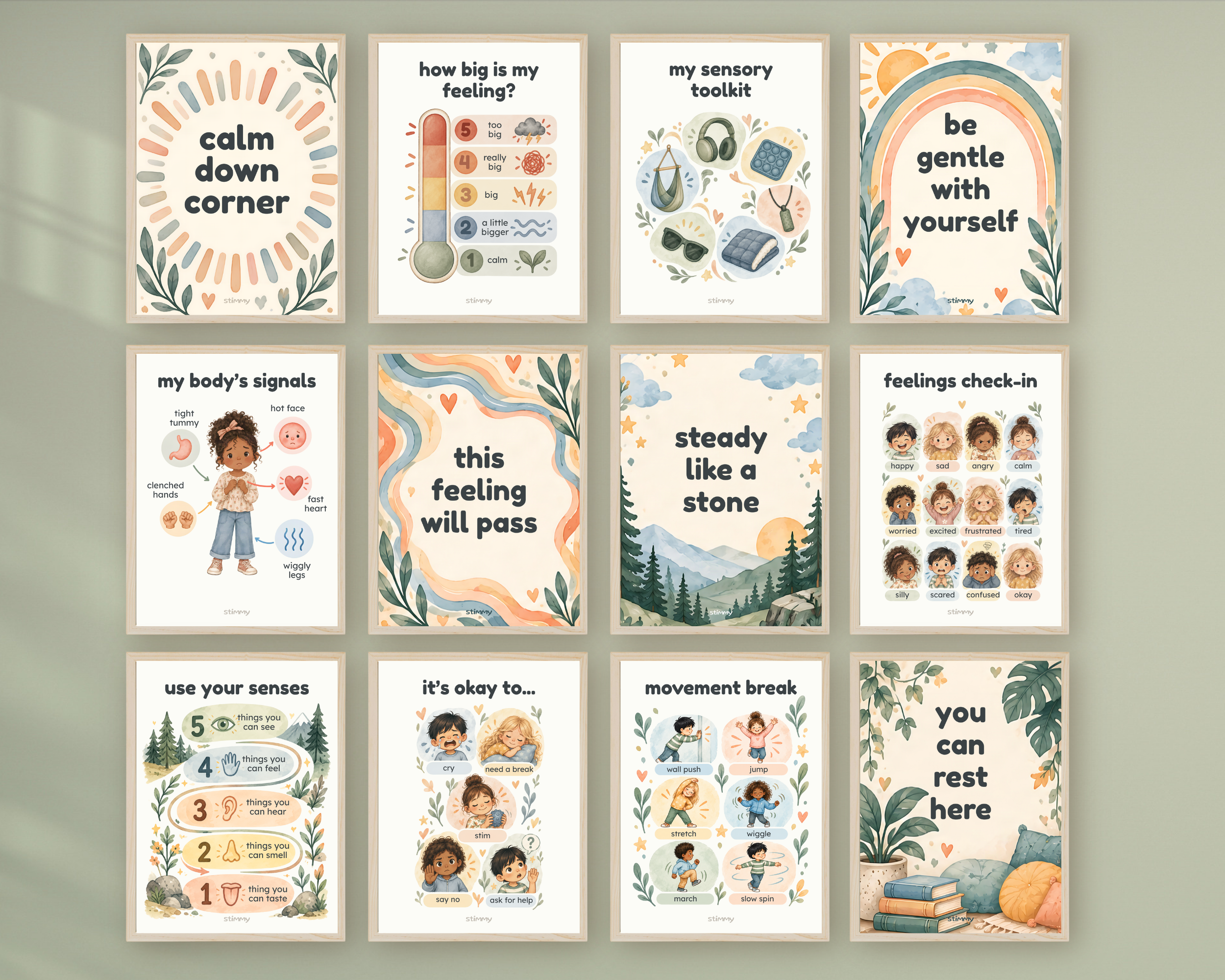
Calm, cozy sensory room decor made by a neurodivergent mom who gets it. 18 printable calm down corner posters to help little bodies notice big feelings, breathe, and find their calm.
Is a calm corner worth a try?
There's no “right” way to build a calming corner. Some kids love it on day one. Others ignore it for three months, then curl up there on a random Tuesday like it was their idea all along.
What I keep coming back to is this:
If feelings are hard to find on the inside, it makes sense to put a few on the outside. A printable feelings chart is one small, low-pressure way to try that.
As always, take what's useful, leave the rest. You know your kid best!
Air hugs,

Sources
Shaw, P., Stringaris, A., Nigg, J., & Leibenluft, E. "Emotional dysregulation and Attention-Deficit/Hyperactivity Disorder." American Journal of Psychiatry, 2014. https://pmc.ncbi.nlm.nih.gov/articles/PMC4282137
Palser, E. R., Galvez-Pol, A., Palmer, C. E., Hannah, R., Fotopoulou, A., Pellicano, E., & Kilner, J. M. "Reduced differentiation of emotion-associated bodily sensations in autism." Autism, 2021. https://discovery-pp.ucl.ac.uk/id/eprint/10120256 (DOI: 10.1177/1362361320987950)
Mahler, K., Hample, K., Jones, C., Sensenig, J., Thomasco, P., & Hilton, C. "Impact of an Interoception-Based Program on Emotion Regulation in Autistic Children." Occupational Therapy International, 2022. https://doaj.org/article/28985ccf2657474f96557484c81db74c (DOI: 10.1155/2022/9328967)
Kinnaird, E., Stewart, C., & Tchanturia, K. "Investigating alexithymia in autism: A systematic review and meta-analysis." European Psychiatry, 2019. https://pmc.ncbi.nlm.nih.gov/articles/PMC6331035
Sam, A., & AFIRM Team. "Visual Supports" brief packet (summarizing Steinbrenner et al., 2020, National Clearinghouse on Autism Evidence and Practice). UNC Frank Porter Graham Child Development Institute, 2024 update. https://afirm.fpg.unc.edu/wp-content/uploads/Visual-Supports-Brief-Packet.pdf
