
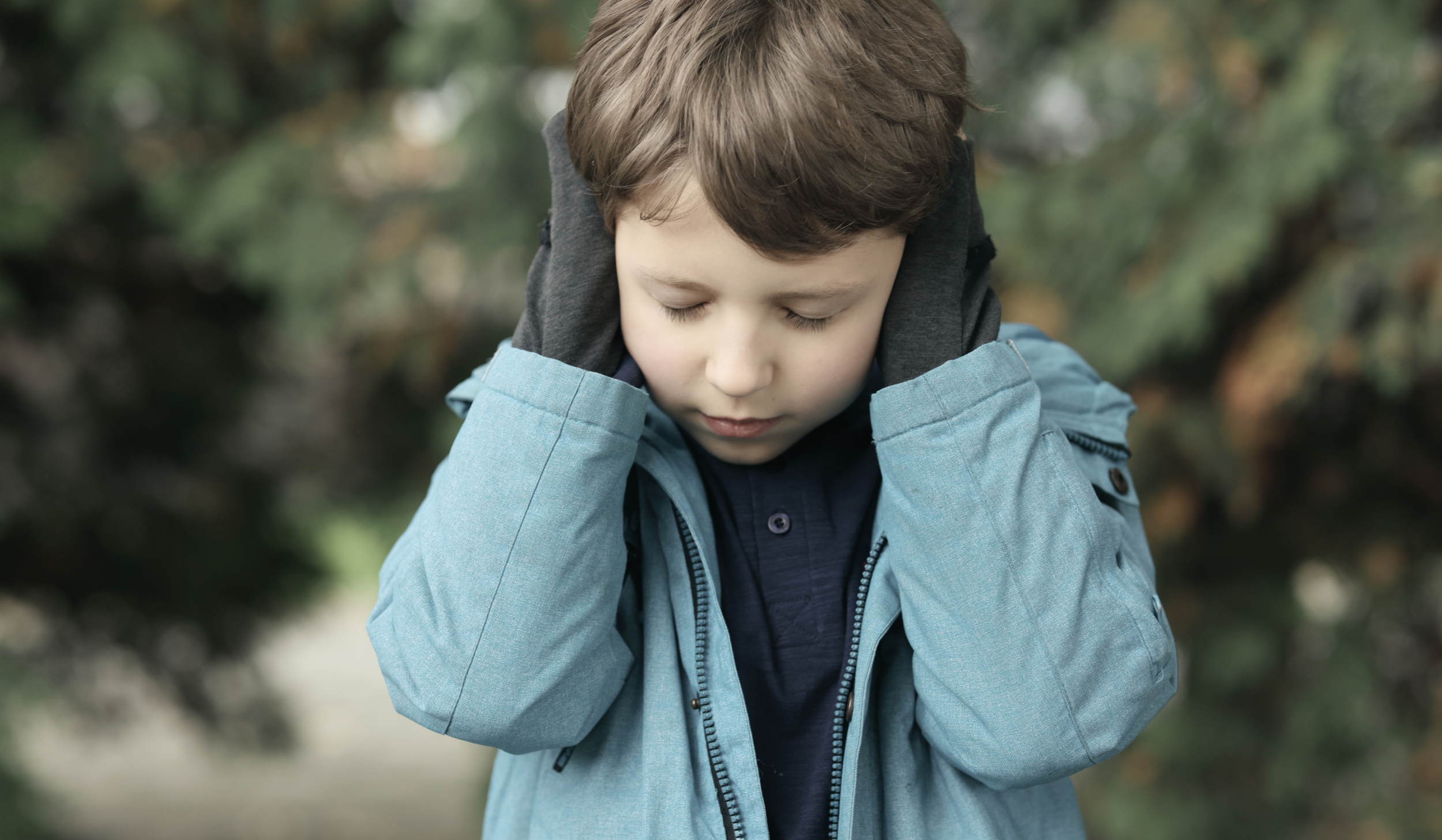
What do autism spectrum sensory issues look like at home?
I'll admit something up front: I am not a noise person. The dishwasher finishes with its cheerful little song, someone asks me a question mid-sentence, a pet barks at absolutely nothing, and suddenly I can't remember why I walked into the kitchen.
So you'd think I'd recognize autism spectrum sensory issues the second I saw them.
Reader, I did not.
For years, I chalked that up to being tired, grumpy, or just "a lot." It took watching my kids (and a lot of late-night reading about autism spectrum sensory issues) to see it differently. Especially after school, or at the end of a long day, when everybody's tank is empty.
Maybe you know the look:
The sock that was fine at 8 a.m. is suddenly unbearable by 4.
Someone hums at the dinner table, and it's the worst sound in the world.
Backpack on the floor, shoes off mid-hallway, and zero words left for "How was your day?"
I started noticing their "too much" looked a lot like my "too much." I'd just had a few extra decades to practice hiding it.
If you're a late-diagnosed parent too, this might sound familiar. A lot of us start out researching our kids and keep recognizing ourselves.
The short version of what I found? There's a real, measurable reason some brains hit their limit faster, and it has nothing to do with being "dramatic."
What's going on in the brain during sensory overload?
Let's picture a quick run to the grocery store...
→ The lights hum
→ The cart wheel squeaks. Every. Single. Turn.
→ Someone's perfume is doing a lot
→ A sock seam has gone rogue
→ And a cashier says "Hi, buddy!" from way too close
For a lot of autistic and ADHD kids, each of those feels like its own fire alarm.
Yes… an actual alarm.
In a 2015 UCLA study, researchers scanned the brains of autistic kids and teens while they heard traffic noise and felt a scratchy fabric on their arm. The kids most bothered by sounds and textures showed stronger responses in the amygdala, the brain's threat alarm. It got even bigger when sound and touch hit at the same time.
The really interesting part? Every kid, neurodivergent or not, reacted to the sensory input at first. But most brains settled after a few seconds. The most sensitive kids took much longer to adjust to the same sound.
A 2019 follow-up in the American Journal of Psychiatry looked at 42 autistic kids and teens, ages 8 to 17. The most sensory-sensitive kids had trouble staying settled as the sensations kept coming. Their brains would calm down, then flare right back up.
So it's less "overreacting" and more a smoke detector that keeps beeping long after the toast stopped burning. And it stacks. The fifth loud thing lands on a brain still reacting to the first four.
Sensory overload isn't a choice or a mood. It's a nervous system sounding the alarm, and having a hard time turning it off.
What does the research say about autism spectrum sensory issues?
Zoom out, and the bigger studies agree. Sensory stuff isn't a side quest in autism. It's actually pretty central.
Over-responsivity stands out most. A 2019 review in the Journal of Autism and Developmental Disorders pooled 55 studies with more than 4,600 autistic people. Being overwhelmed by sensations, under-responding to them, and seeking them out were all much more common than in non-autistic peers. Over-responsivity even set autistic kids apart from kids with other developmental differences.
NOTE: These were mostly parent and self-report questionnaires. And the authors are upfront that why it happens is still unknown.
ADHD brains have been in this club the whole time.
This one surprised me. A 2025 review in the Journal of the American Academy of Child and Adolescent Psychiatry looked at 30 studies with over 5,000 people, most of them kids. People with ADHD had noticeably more sensory differences than those without. That meant being extra sensitive, seeking more input, and sometimes not noticing input at all.
In everyday life, maybe something like:
The kid who can't hear their own name but hears a chip bag open two floors away
The kid who can't handle the cafeteria, then asks to be spun in circles at recess
NOTE: The studies varied a lot. Only 9 of the 30 were rated low risk of bias, and sensory seeking can be hard to tell apart from plain old ADHD wiggles. Still, the authors argue sensory processing deserves a look whenever a kid is evaluated for ADHD.
So if you've been googling "sensory overload ADHD" and wondering if that's a thing… it's a thing.
What do sensory processing disorder (SPD) symptoms look like day to day?
According to the Child Mind Institute, sensory differences are real, but SPD isn't an official diagnosis on its own. They often show up alongside autism, ADHD, or OCD, and sometimes with no other diagnosis at all.
Child Mind describes two main patterns, and lots of kids have both:
Over-sensitive: bright lights, loud noises, scratchy clothes, and surprise touch feel like way too much
Under-sensitive: touching everything, constant fidgeting, and loving deep pressure, spinning, and crashing into the couch
It can also look like a kid who was "fine" all day and falls apart the second they get home. (That one has its own name: after-school restraint collapse.)
📖 RELATED: Restraint Collapse: Why Kids Fall Apart After School
How do other families handle sensory overload?
I can't soundproof my house, and I'm guessing you can't either. But most of the ideas researchers and parents keep circling back to boil down to one thing: less input, especially at the end of the day. Here's a grab bag. Keep what fits your kid, skip the rest!
Accommodations for sensitive ears:
Turn the TV down (or off) for the first hour after school. Remember how the UCLA kids' brains reacted even harder when sound and touch hit at once? Fewer things going at the same time means less to stack.
Keep noise-canceling headphones or earplugs by the door. Autism Spectrum Australia lists headphones as a basic in their quiet room guide.
Turn off notification dings on every device. Yes, even yours. (Especially mine, honestly.)
Run the dishwasher and the blender after bedtime, if you can swing it.
Ball State researcher Shireen Kanakri has watched this play out in her lab. As room noise climbed from quiet to restaurant-level to loud, autistic kids covered their ears and showed distress more often.
Accommodations for sensitive eyes:
Close the curtains or blinds during the brightest part of the afternoon.
Swap the overhead light for a lamp. That small 2023 quiet room study in the Journal of Accessibility and Design for All found softer, lower-contrast lighting seemed linked to calmer behavior.
Skip fluorescent bulbs where you can. Kanakri's earlier work suggested their hum may be too much for some autistic kids.
Keep sunglasses in the car for the ride home.
Clear the visual clutter in at least one spot. (Yes, the laundry pile counts. No, I haven't dealt with mine.)
Accommodations for sensitive noses:
Go easy on candles, plug-ins, and strong cleaners. Smell sometimes get forgotten, but they’re right there on Child Mind Institute's list of senses that can feel like too much.
Crack a window when dinner smells take over the house.
Accommodations for sensitive bodies:
Comfy clothes the second they walk in. Tags and seams included.
Some kids actually settle with more input: a tight hug, a beanbag crash, a few big jumps. Child Mind notes that under-sensitive kids often crave deep pressure and movement.
None of this is about toughening kids up. Dr. Shulamite Green, who led the UCLA research, has suggested support might focus on "creating coping skills to deal with stimulating environments," instead of trying to change how a kid's senses work. Turning the house down a notch is part of that.
Why does a calm corner help with sensory overload?
Even with every light dimmed, a house is still a house. Somebody's going to drop a pan. So the other idea I kept running into is giving kids one spot that's always quiet and always theirs. Especially after school, when they walk in already running on empty.
Autism Spectrum Australia's guide makes two points I loved. A calm space works best when it lowers stimulation. And autistic adults in the research they cite said having control over the space matters a lot.
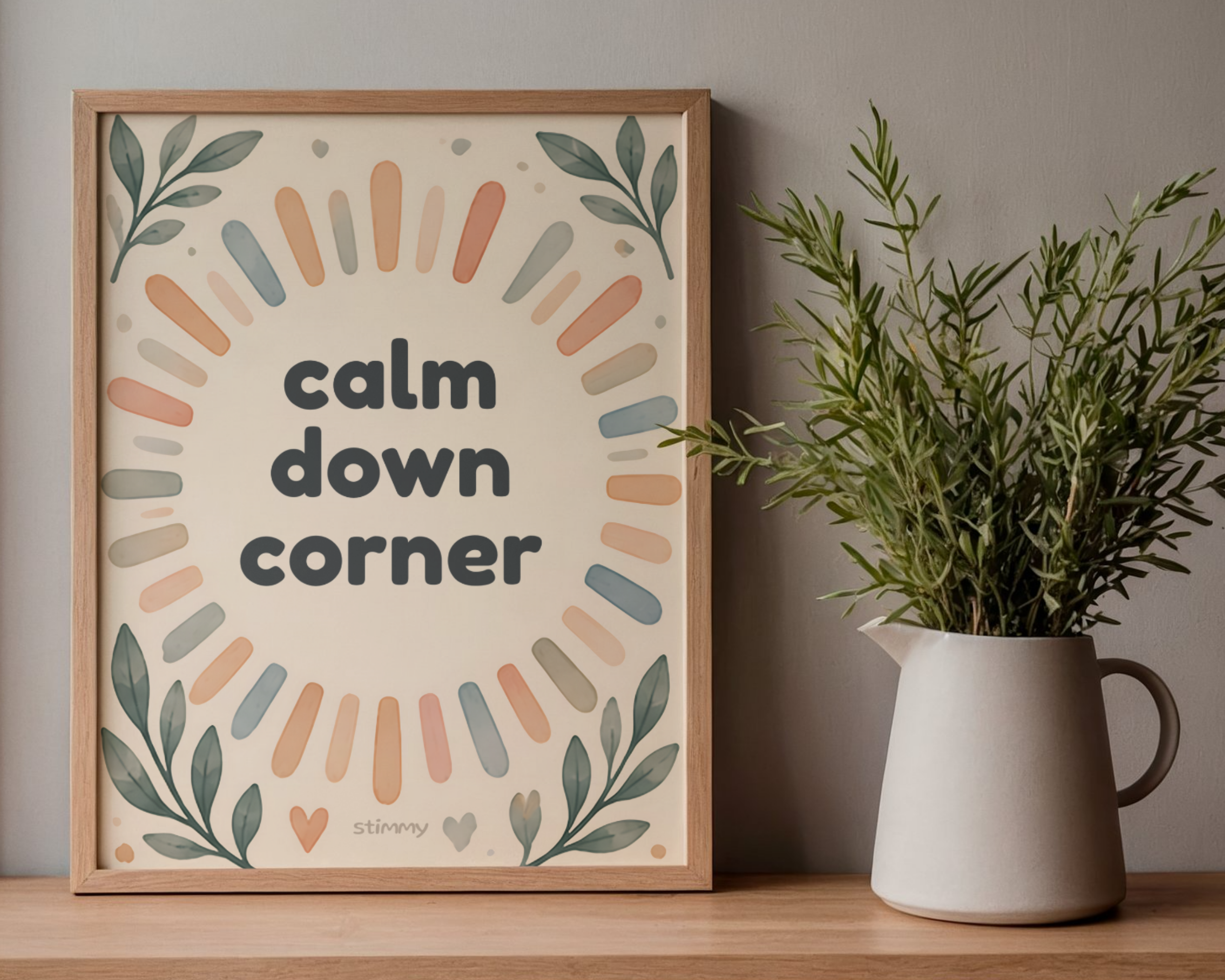
Not a time-out spot. An anytime spot.
Somewhere a kid can choose to go, no questions asked, whenever the world gets too loud.
A few quick ideas for setting up your calm corner:
A corner, closet, or blanket fort that feels a little tucked away
Soft light, like a lamp or string lights
Something squishy: a beanbag, floor cushion, or a pile of pillows
Headphones and a favorite stim toy within reach
A printable feelings chart for pointing when words are offline
Calm, simple things on the wall (more on that in a sec)
I'll dig into calm corner setups in a future post—hang tight!
The art I made for our calm corner
Okay, confession. When I went looking for calm corner posters, everything I found was... loud. Rainbows on rainbows. Cute for a party, less cute for a brain that's already at max volume.
So I made our own. Soft, earthy watercolors, lots of breathing room, and simple pictures a kid can look at, point to, and breathe with. Then I figured, why keep the cozy to ourselves? I turned them into a set of 18 you can print for your own calm corner.
If you'd like a little calm for your corner, the poster bundle is right below. Consider it a tiny care package from my overstimulated house to yours.
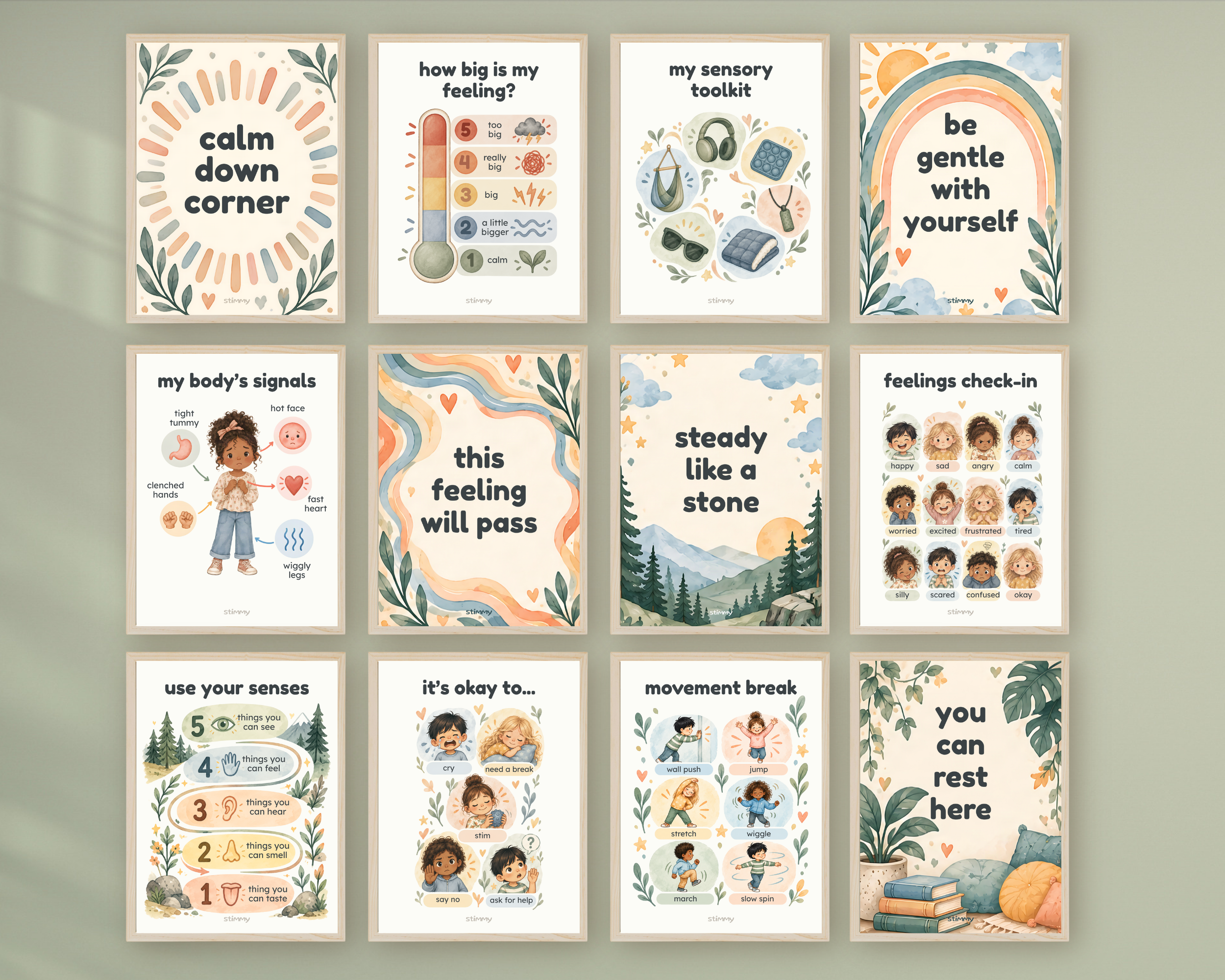
Calm, cozy sensory room decor made by a neurodivergent mom who gets it. 18 printable calm down corner posters to help little bodies notice big feelings, breathe, and find their calm.
Living with autism spectrum sensory issues, one loud day at a time.
If your kiddo falls apart after the grocery store, it may mean their brain is working overtime to quiet an alarm the rest of us barely hear.
That's exhausting for everybody. But understanding the why made me a lot gentler—with my kids and with myself.
I don't have this figured out. Some days, the humming at dinner still wins. But knowing what's going on behind the meltdown makes the loud days feel a lot less mysterious.
Air hugs,

Sources
Ben-Sasson, A., Gal, E., Fluss, R., Katz-Zetler, N., & Cermak, S. A. "Update of a Meta-analysis of Sensory Symptoms in ASD: A New Decade of Research." Journal of Autism and Developmental Disorders, 2019. https://doi.org/10.1007/s10803-019-04180-0
Green, S. A., Hernandez, L., Lawrence, K. E., et al. "Distinct Patterns of Neural Habituation and Generalization in Children and Adolescents With Autism With Low and High Sensory Overresponsivity." American Journal of Psychiatry, 2019. https://psychiatryonline.org/doi/abs/10.1176/appi.ajp.2019.18121333
Jurek, L., Duchier, A., Gauld, C., et al. "Sensory Processing in Individuals With Attention-Deficit/Hyperactivity Disorder Compared With Control Populations: A Systematic Review and Meta-analysis." Journal of the American Academy of Child & Adolescent Psychiatry, 2025. https://doi.org/10.1016/j.jaac.2025.02.019
UCLA Health. "Children with autism who are overly sensitive to stimuli have brains that react differently" (about Green et al., JAMA Psychiatry), 2015. https://www.uclahealth.org/news/release/children-with-autism-who-are-overly-sensitive-to-stimuli-have-brains-that-react-differently
Child Mind Institute. "Sensory Processing FAQ," updated 2024. https://childmind.org/article/sensory-processing-faq/
Marwati, A., Candra Dewi, O., Wiguna, T., & Aisyah, A. "Visual-sensory-based quiet room." Journal of Accessibility and Design for All, 2023. https://upcommons.upc.edu/entities/publication/5bbfdaba-a8a8-4fc6-9327-f7a7f4bc21bc
Autism Spectrum Australia (Aspect). "Quiet Room vs Sensory Room" information sheet. https://www.aspect.org.au/uploads/documents/Information-Sheets/Quiet-Room-vs-Sensory-Room-information-sheet.pdf
